
 Advanced
BRAIN & MIND
How a Habit Forms
- 12 spell
- 8 known
- 2 semi-open
- 6 open
- 2 math
WHEN HABIT TAKES THE WHEEL
On a Saturday morning you set out for the hardware store, and ten minutes later you are idling at the INTERSECTION two blocks from your office. Nothing went wrong with your attention; something went right with your training. Cognitive scientists call this a CAPTURE error — a well-practiced routine seizes control of behavior when its familiar trigger appears, overriding the intention you actually held. The drive to work has acquired AUTOMATICITY: it runs off cues in the environment rather than off deliberate decisions, releasing conscious effort for other things and reclaiming it only when the result turns out wrong.
- SPELLAUTOMATICITY
- SPELLINTERSECTION
- KNOWNWhat is the term for the error in which a well-practiced routine seizes control of your behavior because its familiar trigger appeared?Answer: CAPTURE
- OPENWhat cue along that Saturday route would you expect to pull a driver toward the office instead of the hardware store?
THE LOOP AND ITS CIRCUITRY
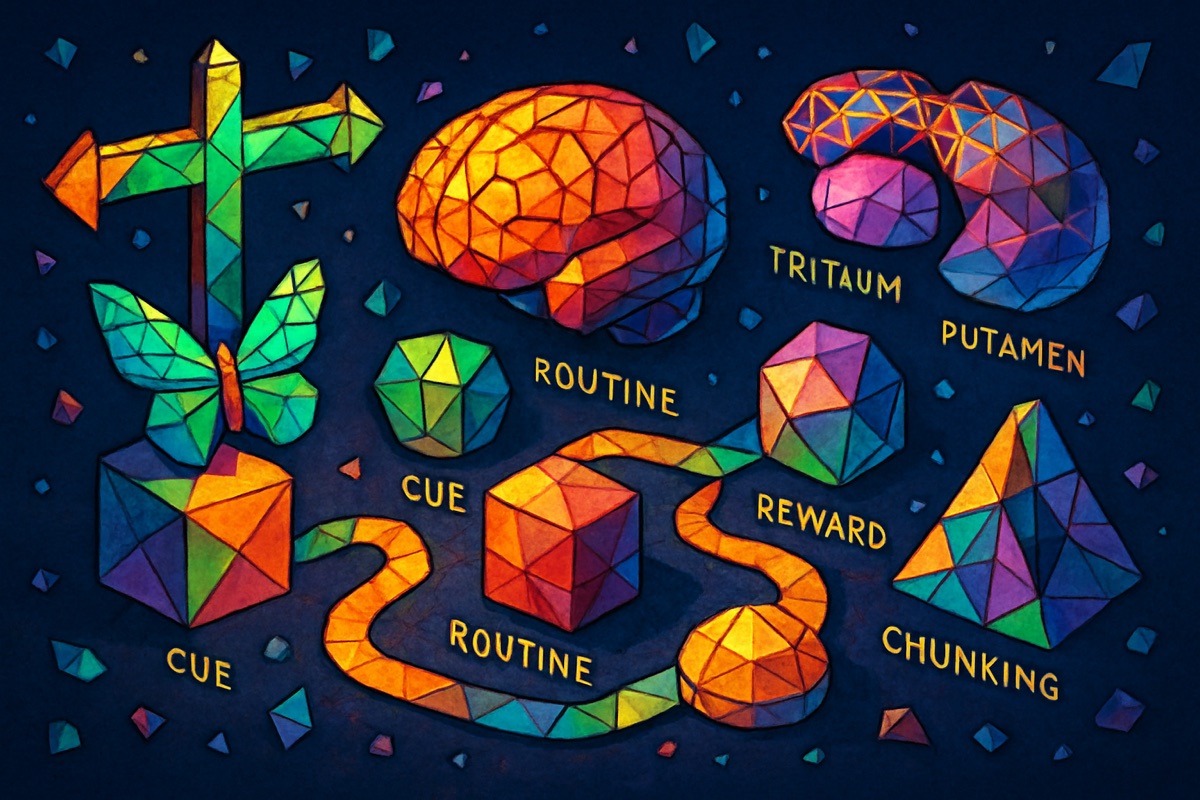
Every established habit resolves into three linked elements. A CUE — a time, a place, a preceding action — opens the sequence; a ROUTINE, the behavior itself, runs next; a REWARD, the outcome the brain registers as worth having, closes it. The learning that binds them together happens largely in the basal ganglia, a set of deep FOREBRAIN structures whose main input hub is the STRIATUM. Early in training, the CAUDATE supports flexible, deliberate action. With repetition, control migrates toward the PUTAMEN, the striatal territory that stores well-drilled motor sequences and reruns them under little cortical supervision.
- SPELLPUTAMEN
- SPELLFOREBRAIN
- KNOWNWhat is the name of the basal ganglia's main input hub, the region that contains both the caudate and the putamen?Answer: STRIATUM
- KNOWNEarly in training, which striatal structure supports flexible, deliberate action?Answer: CAUDATE
- SEMI-OPENName two of the three elements every established habit resolves into.Needs 2 of: CUE, ROUTINE, REWARD
- OPENWhat time of day or place tends to open one of your own daily routines?
- MATHHabit-formation research puts the median time to reach automaticity at 66 days, while the fastest participants got there in 18 days. How many more days did the median take than the fastest?Answer: 48
TWO NEURAL SIGNATURES
Two neural signatures mark the transition. The first is dopaminergic: dopamine neurons that initially fire when a reward arrives come, with training, to fire at the stimulus that predicts it instead, and to fall silent when the expected outcome fails to appear. That shift expresses a reward PREDICTION error, the signal encoding the gap between what was expected and what actually occurred, which drives learning until predictions stop being violated. The second is CHUNKING, the COMPRESSION of a repeated sequence into a single unit. Striatal recordings show activity massing at the start and finish of a well-learned run and thinning in between — task BRACKETING.
- SPELLBRACKETING
- SPELLCOMPRESSION
- KNOWNDopamine neurons signal the gap between what was expected and what actually happened. What kind of error is that signal called?Answer: PREDICTION
- KNOWNWhat is the name for packing a repeated sequence of actions into a single unit the brain runs as one?Answer: CHUNKING
- OPENWhat is something you expect to happen so reliably that you would notice right away if it did not?
- MATHSuppose a well-learned lever sequence contains 12 presses, and chunking compresses every 4 presses into a single unit. How many units does the sequence become?Answer: 3
DECOUPLED FROM THE OUTCOME
Automaticity is not the same thing as wanting. The standard test is outcome DEVALUATION: an animal trained to press a lever for food is then made AVERSE to that food, or fed until it is sated, and returned to the lever. Moderately trained animals cut back at once, because their behavior still consults the value of the goal. Animals given extended OVERTRAINING keep pressing — the response has been cut loose from the outcome that built it. Stress sharpens the effect, pushing behavior away from deliberate evaluation and toward stored routines precisely when flexible judgment would help most.
- SPELLOVERTRAINING
- SPELLAVERSE
- KNOWNWhat is the test called in which an animal is made sick of the food it worked for, or fed until full, and then returned to the lever?Answer: DEVALUATION
- OPENSuppose an animal is made sick of the food it once pressed the lever for. What would you expect it to do the next time it meets that lever?
WHAT HOLDS A HABIT IN PLACE
The folk arithmetic of habit is also wrong. Volunteers who adopted a new daily behavior reached stable automaticity after a median of roughly 66 days, but individuals ranged from about 18 days to more than 250. What steadies a habit is the constancy of its context: the LOCATION, the TIME of day, the MOOD, and the PEOPLE surrounding the act. Change these at once — a move, a new job — and the trigger structure collapses, the habit DISCONTINUITY effect that makes relocations unusually good moments to rebuild behavior. Suppression is not erasure, though: disrupting the INFRALIMBIC CORTEX in rodents can strip a recent habit and expose an older one intact beneath it.
- SPELLINFRALIMBIC
- SPELLCORTEX
- KNOWNWhat is the effect called in which a move or a new job collapses every surrounding cue at once, making relocation a good moment to rebuild behavior?Answer: DISCONTINUITY
- SEMI-OPENA habit stays steady when its context stays constant. Name two features of that context.Needs 2 of: LOCATION, TIME, MOOD, PEOPLE
- OPENIf you moved to a new place next month, which of your daily routines do you think would be hardest to keep going?
TRIGGERS AND PLATEAUS
Your leverage sits at the front of the loop, not the back. Resolving to exercise more names an outcome; naming an if-then plan — if it is Tuesday evening and I have parked the car, then I walk straight into the gym — hands the behavior a concrete trigger, and researchers find such IMPLEMENTATION intentions raise follow-through because the cue, rather than your resolve, starts the act. Expect the automaticity curve to climb steeply at first and then approach an ASYMPTOTE, the plateau past which further REPETITIONS add almost nothing. Missing a single day does not measurably set that curve back.
- SPELLASYMPTOTE
- SPELLREPETITIONS
- KNOWNWhat is the term for an if-then plan that hands a behavior a concrete trigger instead of just naming the outcome you want?Answer: IMPLEMENTATION
- OPENIf you were writing an if-then plan for yourself, what everyday moment would you pick as the trigger?
Enjoy the lesson? Get the TBoard app


- Lally et al. (2010) — How are habits formed: modelling habit formation in the real world
- Graybiel (2008) — Habits, rituals, and the evaluative brain
- Schultz, Dayan & Montague (1997) — A neural substrate of prediction and reward
- Wood & Neal (2007) — A new look at habits and the habit–goal interface
- Gollwitzer (1999) — Implementation intentions: strong effects of simple plans